
Comparing long-term costs of Duo-Lase and traditional gum surgery
Investing in Your Smile's Future: A Long-Term Cost Comparison of Duo-Lase™ vs. Traditional Gum Surgery
Imagine sitting in a chair, expecting a routine check-up, only to hear the words that instantly tighten your chest: "You have advanced gum disease, and you might lose these teeth."
In that moment, the immediate worry is often emotional—the fear of losing your smile or the anxiety of surgery. But as the dust settles, a second, equally pressing concern arises: the financial reality.
When faced with a treatment plan, it is natural to look at the bottom line today. However, your teeth are arguably one of your most undervalued financial assets. Treating gum disease isn’t just a medical expense; it’s an investment strategy. The decision between traditional surgical methods and modern laser therapy isn't just about which procedure is "cheaper" right now—it’s about which one offers the highest return on investment (ROI) over the lifetime of your smile.
This guide explores the concept of "Economic Biology"—understanding how the biological method of healing you choose today dictates the financial costs you will face five, ten, or twenty years down the road.
The Tale of Two Approaches: Resection vs. Regeneration
To understand the cost, you first have to understand the mechanism. Traditional gum surgery and Duo-Lase™ are not just different tools; they are opposing philosophies.
Traditional Surgery: The "Resective" Approach
Think of a tree with an infection in the soil. Traditional surgery is comparable to digging up the roots, cutting away the infected branches, and hoping the tree survives the shock. In dental terms, this is "resective" surgery. The goal is to cut away diseased gum tissue and sometimes shave down the bone to reduce the "pockets" where bacteria hide. While effective at removing disease, it often results in the loss of biological material that you can never get back.
Duo-Lase™: The "Regenerative" Approach
Duo-Lase™ acts more like treating the soil so the tree can heal itself. It is a "regenerative" therapy. By using specific wavelengths of light, this method vaporizes bacteria and diseased tissue while leaving healthy tissue intact. More importantly, it stimulates the body’s own stem cells to regenerate bone and ligament. You aren't subtracting from your body; you are energizing it to rebuild.
The "10x Rule" of Tooth Preservation
One of the most common financial pitfalls patients fall into is comparing the cost of laser treatment per quadrant against the cost of an extraction. It seems cheaper to pull a tooth than to save it. However, this view ignores the "10x Rule."
Saving a natural tooth with Duo-Lase™ might represent an upfront investment, but replacing that same tooth with a dental implant can cost 5 to 10 times more over your lifetime.
Why the disparity?
The Implant Myth: We often view implants as a "forever" fix, but they are susceptible to their own form of gum disease known as peri-implantitis. If you are prone to gum disease, you are at higher risk for peri-implantitis stages that can lead to implant failure.
Maintenance: Natural teeth have a biological seal against bacteria that implants lack. Maintaining a regenerated natural tooth is generally less expensive than the long-term maintenance, hardware replacement, and potential grafting required for implants.
The Hidden Costs: Recovery and Recession
When analyzing the duo lase cost versus traditional surgery, we must look beyond the clinic invoice. We have to factor in the "Life Interruption" costs.
The Cost of Recovery
Time is money. Traditional periodontal surgery often involves scalpels, sutures, and significant downtime.
Traditional: Recovery can take 2 to 4 weeks. This often involves prescription painkillers, dietary restrictions, and potentially lost wages due to time off work.
Duo-Lase™: Most patients return to their daily routine immediately. There are no incisions and no sutures.
For professionals or business owners, the ability to utilize faster recovery periodontal procedures translates to a direct financial benefit by minimizing lost productivity.
The "Recession Tax"
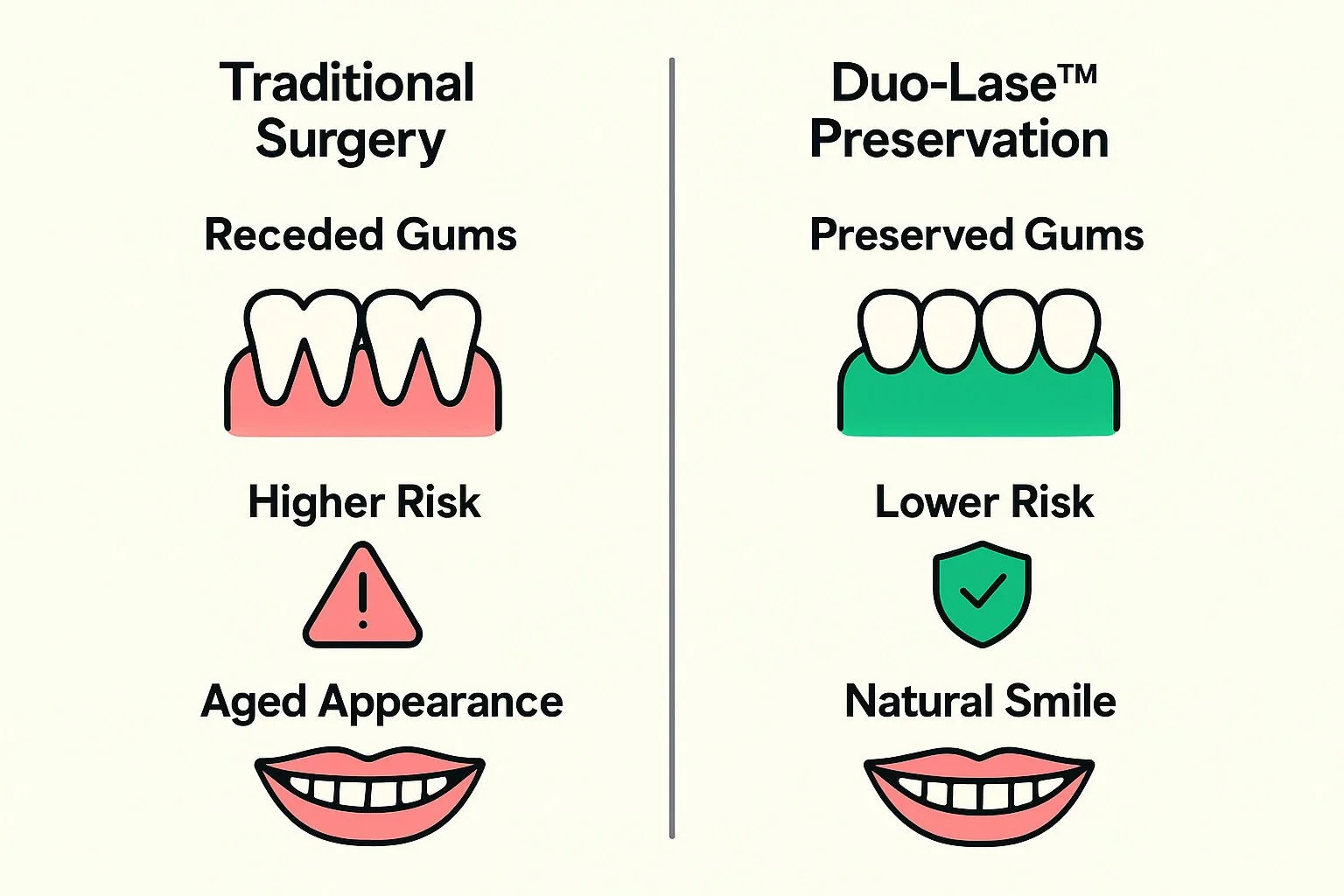
There is also an aesthetic cost to traditional surgery. Because resective surgery involves cutting away gum tissue, a common side effect is gum recession. This leads to:
"Long" Teeth: The roots become exposed, which can make you look older.
Sensitivity: Exposed roots are highly sensitive to hot and cold.
Future Procedures: Many patients eventually pay thousands for gum grafts or cosmetic veneers to fix the aesthetic damage caused by the initial surgery.
Duo-Lase™ minimizes this recession risk, preserving your natural gum line and your smile's youthful appearance without the need for additional cosmetic fixes later.
Precision Diagnostics: The Micro-Perio Advantage
A major factor in the ROI of Duo-Lase™ at The Behrens Dental Practice is the precision of the diagnosis. "Blind" treatment is expensive because it might not work.
Before the laser is even turned on, the team performs a Micro-Perio Analysis. This involves a microbiological DNA test to identify exactly which bacteria are causing your specific infection.
Traditional Approach: Often treats all gum disease the same way (mechanical cleaning or cutting).
Duo-Lase™ Approach: Tailors the treatment plan based on your bacterial DNA profile.
By targeting the root cause with such precision, the risk of recurrence drops significantly. This keeps you out of the dental chair in the future, protecting your investment.
Frequently Asked Questions
Is Duo-Lase™ covered by insurance?
Coverage varies by provider, but many insurance plans that cover periodontal surgery will provide benefits for laser therapy. It is best to check with your provider regarding "laser-assisted new attachment procedure" or periodontal decontamination codes.
Does the treatment hurt?
This is often the biggest surprise for patients. Because Duo-Lase™ uses light energy rather than sharp instruments to remove diseased tissue, the procedure is minimally invasive. Patients frequently report little to no discomfort during the procedure and require minimal pain management afterward.
How does this compare to LANAP?
While similar principles apply, Duo-Lase™ utilizes a dual-laser protocol combining Photo-Dynamic Pocket Decontamination (to kill bacteria) and Bio-Stimulation (to heal tissue). This comprehensive approach is designed to maximize tissue regeneration. You can read duo-lase reviews to see how patients describe their experience.
Can bone really grow back?
Yes. Unlike traditional surgery which removes bone, the specific laser wavelengths used in Duo-Lase™ stimulate the stem cells in your jaw, promoting the regeneration of bone and the periodontal ligament that holds your teeth in place.
The Verdict on Value
When you view your oral health through the lens of long-term value, the choice becomes clearer. Traditional surgery may offer a lower sticker price today, but the biological costs—tissue loss, recession, and longer recovery—can accrue high interest over time.
Duo-Lase™ offers a path to not just arresting disease, but reversing it. By preserving your natural teeth and regenerating your own biology, you are securing the future of your smile and protecting your wallet from the high costs of tooth replacement.
Are you ready to stop the cycle of gum disease and start the process of regeneration? The first step is understanding your unique situation through a comprehensive analysis.